

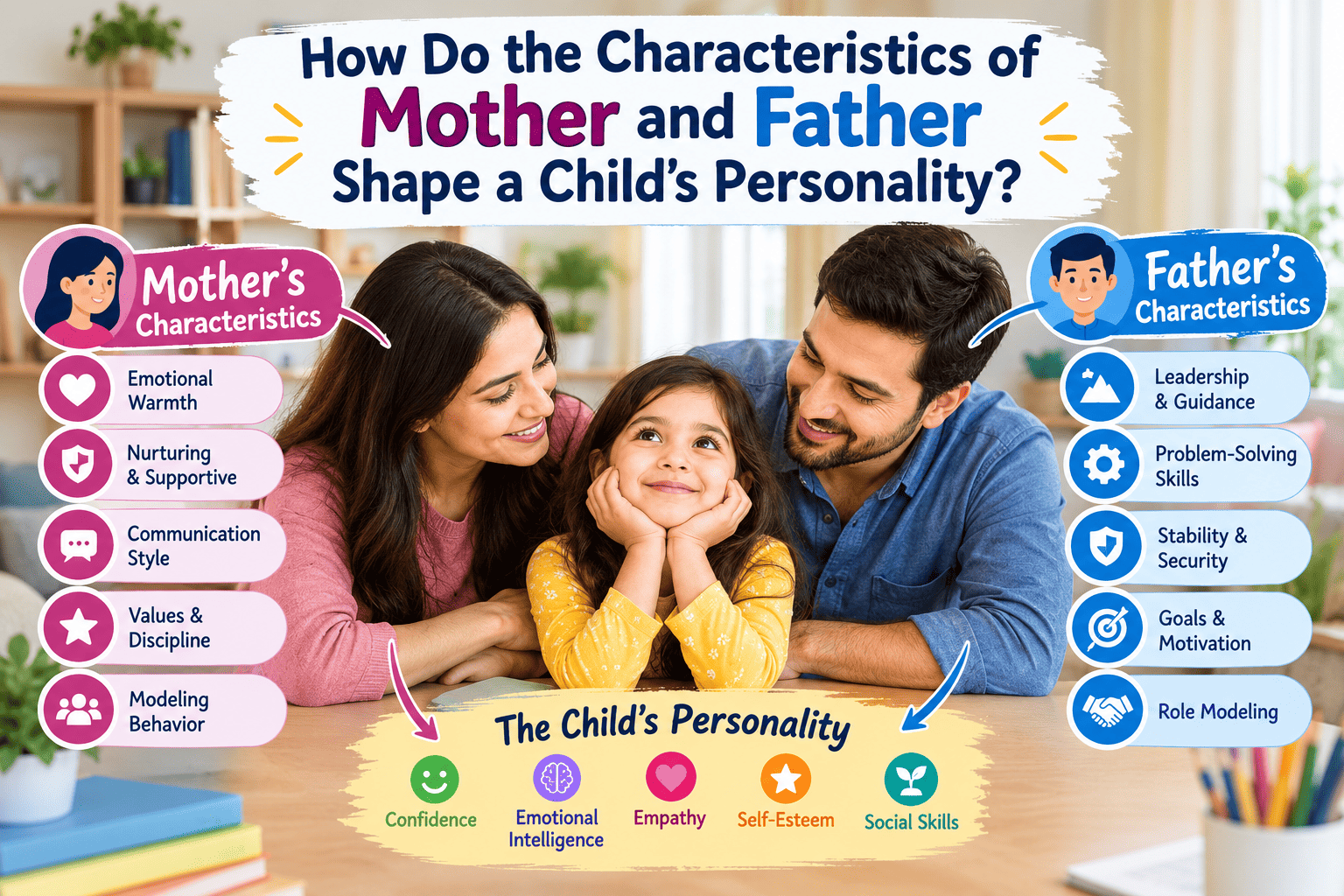
The characteristics of a mother and father can influence a child’s personality through genetics, parenting styles, communication, emotional support, and everyday behavior. Children may learn kindness, confidence, responsibility, patience, and problem-solving by observing their parents. However, personality is not determined by parents alone. A child’s temperament, experiences, friendships, education, and wider environment also contribute to individual development.
Introduction
A child’s personality develops through a combination of inherited characteristics, family relationships, life experiences, and the environment in which they grow up. From early childhood, children observe how their parents communicate, manage emotions, solve problems, and interact with other people. These everyday experiences can influence how children understand themselves and the world around them.
When exploring how the characteristics of mother and father shape a child’s personality, it is important to recognize that both parents can contribute in different ways. A mother may provide emotional support and guidance, while a father may demonstrate encouragement and problem-solving. However, these qualities are not limited to either parent. Mothers and fathers can both nurture, teach, protect, discipline, and inspire their children.
The most important factor is often the quality of the relationship rather than whether a particular behavior comes from the mother or father. A supportive family environment can help children develop emotional security, healthy relationships, independence, and confidence as they grow.
1. How a Mother’s Characteristics Influence a Child’s Personality
A mother’s behavior and personality can influence a child through everyday interactions, emotional support, communication, and guidance. When a mother listens carefully, responds calmly, and shows affection, a child may learn that expressing feelings is acceptable and that relationships can provide comfort and security.
For example, when a child feels disappointed after a difficult day at school, a mother who listens without immediately criticizing can help the child understand their emotions. Over time, these experiences may encourage emotional awareness, trust, and the ability to communicate feelings appropriately.
A mother’s patience can also provide an example of how to manage frustration. If she explains mistakes calmly and encourages children to try again, they may learn persistence and problem-solving. Similarly, showing honesty, kindness, and responsibility can help children understand how these values apply in everyday life.
However, no mother needs to be perfect to support healthy development. Parents sometimes feel stressed, make mistakes, or react emotionally. What matters is their willingness to acknowledge mistakes, repair relationships, and continue providing dependable care.
2. How a Father’s Characteristics Shape a Child’s Personality
A father’s characteristics can also contribute to a child’s emotional, social, and behavioral development. Fathers who communicate respectfully, show affection, provide guidance, and encourage independence can help children develop confidence and a sense of responsibility.
For instance, when a father encourages a child to attempt a challenging school project rather than completing it for them, the child has an opportunity to develop problem-solving skills. If the father offers support without taking control, the child may become more comfortable making decisions and learning from mistakes.
A father’s approach to handling disagreements can influence how children understand conflict. When he listens to different opinions, explains his perspective respectfully, and avoids unnecessary hostility, children can observe constructive communication in action.
Fathers can also contribute through shared activities such as reading, cooking, playing games, completing household tasks, or discussing daily experiences. These interactions create opportunities for learning, connection, and trust.
It is important to remember that confidence, discipline, leadership, and emotional sensitivity are not naturally exclusive to fathers. Any caring parent or caregiver can help a child develop these qualities through consistent encouragement and positive examples.
3. The Importance of Emotional Support
Emotional support is an important part of healthy childhood development. Children need opportunities to feel heard, understood, and accepted while learning how to manage difficult emotions.
When parents respond to their children with warmth and sensitivity, children may gradually develop a stronger understanding of their own feelings. They can learn to identify sadness, frustration, excitement, and fear without feeling ashamed of experiencing them.
Consider a child who becomes nervous before speaking in class. If both parents acknowledge the child’s concern and help them prepare, the child may feel more capable of facing the situation. If the parents dismiss the concern or repeatedly criticize the child, the experience may become more stressful.
Emotional support does not mean agreeing with every decision or avoiding boundaries. Parents can validate a child’s feelings while still teaching appropriate behavior. For example, they can acknowledge anger while explaining that disagreements must be handled respectfully.
A family environment that combines affection with reasonable expectations can help children develop emotional awareness, resilience, and healthier relationships.
4. How Parenting Styles Affect Personality Development
Parenting style refers to the general way parents provide affection, set expectations, communicate rules, and respond to a child’s behavior. Different approaches can create different learning experiences.
Authoritative parenting combines warmth, clear boundaries, and age-appropriate independence. Parents explain rules, listen to their children, and maintain reasonable expectations. Research has associated this approach with several positive personality-related outcomes, although results vary across individuals and cultures.
Authoritarian parenting emphasizes strict rules and obedience, often with limited discussion. Clear boundaries can provide structure, but excessive control or harsh criticism may discourage children from expressing themselves openly.
Permissive parenting provides considerable affection but relatively few consistent limits. Children may feel supported, although they can also need additional guidance in developing self-discipline and responsibility.
Uninvolved parenting involves limited emotional responsiveness or supervision. When children regularly lack attention, support, and appropriate guidance, their social and emotional development may face additional challenges.
These categories describe general patterns rather than fixed labels. Many parents use different approaches depending on the situation, and parenting can change as children mature. A balanced approach that combines warmth, consistency, communication, and reasonable boundaries can support healthy development.
5. The Role of Genetics in a Child’s Personality
Not every characteristic a child displays comes from observing their parents. Genetics also contributes to individual differences in temperament and personality.
Children may inherit tendencies related to emotional sensitivity, activity levels, sociability, or how strongly they respond to unfamiliar situations. However, inheriting a tendency does not mean a child will inevitably develop a particular personality trait or behave exactly like a parent.
For example, a child with a naturally cautious temperament may prefer observing a new situation before participating. Supportive parents can help the child gradually build confidence without forcing them to become someone they are not.
Similarly, a naturally energetic child may benefit from opportunities for movement, structured activities, and patient guidance. Recognizing individual differences helps parents respond to their children’s actual needs instead of comparing them with siblings or expecting identical behavior.
Personality develops through ongoing interactions between biological tendencies and environmental experiences. Genes matter, but they do not provide a complete prediction of a child’s future personality.
6. How Parents Influence Confidence and Self-Esteem
Children gradually develop beliefs about their abilities and personal worth through experiences at home, school, and in social settings. Parents can influence these beliefs through the way they offer praise, respond to mistakes, and encourage new challenges.
When parents recognize effort and progress, children can learn that improvement is possible. For example, instead of praising only a high test score, a parent might acknowledge the time and preparation the child invested in studying.
This approach can encourage persistence because success is not presented as the only measure of ability. Children can also learn that mistakes are opportunities to improve rather than proof that they are incapable.
Constant comparisons with siblings, classmates, or other children may create unnecessary pressure. A child who repeatedly hears that someone else is more intelligent, talented, or successful may begin to question their own abilities.
Parents can support healthy self-esteem by offering realistic encouragement, listening to concerns, respecting individual strengths, and helping children set achievable goals. Confidence grows through a combination of support and opportunities to experience progress independently.
7. The Influence of Parents’ Communication and Behavior
Children learn not only from what parents say but also from how they behave. Everyday interactions can provide examples of honesty, patience, respect, cooperation, and emotional control.
If parents speak politely to others, keep reasonable promises, and acknowledge their mistakes, children can observe these behaviors in practice. When parents disagree respectfully, children can also learn that different opinions do not have to damage a relationship.
On the other hand, frequent hostility, humiliation, or unpredictable reactions can make family interactions more difficult for children to understand. The effect depends on the child’s circumstances, the frequency and intensity of conflict, and the availability of supportive relationships.
Parents do not need to hide every disagreement. Instead, they can demonstrate how disagreements are resolved constructively. Apologizing after an unfair reaction and explaining how to handle a similar situation differently can teach accountability.
Consistent behavior gives children practical examples of how to interact with others, manage responsibilities, and respond to challenges outside the home.
8. How Family Relationships Shape Social Skills
The family is often a child’s first setting for learning social interaction. Through conversations, shared activities, and everyday disagreements, children begin to understand cooperation, boundaries, empathy, and respect.
When parents listen to children and allow them to express different opinions appropriately, children can practice communicating their needs. When parents encourage sharing, taking turns, and considering other people’s feelings, children gain opportunities to develop social awareness.
For example, if siblings argue over a toy, parents can guide them toward taking turns or finding a fair solution. This approach teaches children how to negotiate rather than relying entirely on adults to resolve every disagreement.
Family relationships also influence how children understand trust. Dependable care and respectful communication can help them learn that healthy relationships involve listening, honesty, and mutual consideration.
Nevertheless, parents are not the only source of social learning. Teachers, classmates, relatives, community members, and friendships also help shape children’s social abilities.
9. Can a Mother and Father Have Different Parenting Styles?
Yes. Mothers and fathers may have different personalities, communication habits, expectations, and approaches to discipline. One parent may prefer detailed explanations, while the other may encourage children to learn through practical experience.
Differences do not automatically create problems. Children can benefit from seeing that people approach challenges differently while still respecting one another. For example, one parent might help a child organize a school assignment, while the other encourages the child to brainstorm creative ideas.
Difficulties can arise when parents regularly undermine one another, apply contradictory rules without explanation, or involve children in ongoing disagreements. These situations may make expectations confusing and create unnecessary stress.
Parents can reduce confusion by discussing important family rules, agreeing on reasonable boundaries, and communicating respectfully when they disagree. They do not need identical personalities or parenting methods, but children benefit when the adults caring for them provide dependable guidance.
The goal is not to make both parents behave exactly alike. It is to create a reasonably consistent and supportive environment in which children understand expectations and feel comfortable seeking help.
10. The Influence of the Home Environment
A child’s home environment includes more than the characteristics of the mother and father. It also includes family routines, emotional safety, household expectations, opportunities for learning, and the way family members treat one another.
A predictable routine can help children understand what to expect throughout the day. Regular time for meals, schoolwork, play, sleep, and family conversations can provide structure without making every part of life rigid.
A supportive home environment also allows children to ask questions, express concerns, and explore interests. Reading together, discussing everyday experiences, and encouraging age-appropriate responsibilities can create useful opportunities for learning.
Financial circumstances, housing conditions, parental work schedules, and other sources of stress may influence family life as well. These factors should not be treated as measures of a parent’s love or a child’s potential. Families can support development in different ways depending on their circumstances and available resources.
What matters is creating as much safety, stability, care, and opportunity as reasonably possible.
11. Practical Ways Parents Can Support Healthy Personality Development
Parents can encourage positive development through ordinary, consistent actions rather than expecting themselves to follow a perfect parenting formula.
Listening attentively is a useful starting point. Allowing children to explain their thoughts before offering advice can help them feel respected and teach them how to communicate clearly.
Setting reasonable boundaries is equally important. Children need guidance about responsibilities, safety, respect, and appropriate behavior. Explaining the reasons behind rules can make expectations easier to understand.
Parents can also encourage independence by giving children age-appropriate choices. Selecting a book, organizing school materials, helping with household tasks, or planning a simple activity can provide opportunities to practice decision-making.
Recognizing effort and progress can help children develop persistence. When children struggle, parents can offer guidance without immediately solving every problem for them.
Finally, parents should remember that children have different temperaments and interests. One child may enjoy social activities, while another prefers quieter pursuits. Supporting these differences allows children to develop their abilities without feeling pressured to copy someone else’s personality.
Conclusion
Understanding how the characteristics of mother and father shape a child’s personality involves looking beyond traditional assumptions about the roles of mothers and fathers. Both parents can influence emotional development, confidence, social behavior, responsibility, and communication through their everyday actions and relationships with their children.
Genetics, temperament, parenting styles, family routines, education, friendships, and wider experiences also contribute to personality development. No single characteristic or parenting method guarantees a particular outcome.
The most helpful approach is to provide consistent care, communicate respectfully, establish reasonable boundaries, and encourage children to develop their own strengths. By creating a supportive environment and adapting to each child’s needs, parents can help children build the skills and confidence needed to navigate life.
Frequently Asked Questions
1. How do the characteristics of mother and father influence a child’s personality?
Their behavior, values, communication styles, emotional support, and parenting practices can influence how children develop confidence, social skills, responsibility, and emotional awareness. Genetics and other environmental experiences also play important roles.
2. Does a child inherit personality traits from both parents?
Children inherit genetic material from both biological parents, and genetic differences contribute to temperament and personality. However, inherited tendencies do not determine every aspect of behavior. Life experiences and the environment also influence development.
3. Which parenting style is best for personality development?
Authoritative parenting, which combines warmth, clear expectations, and appropriate independence, is associated with several positive developmental outcomes. However, children and families differ, and no parenting style guarantees a specific personality or outcome.
4. Can parents change a child’s personality?
Parents cannot completely control a child’s personality, but they can influence the environment in which it develops. Supportive relationships, constructive communication, consistent boundaries, and opportunities to learn can help children develop useful social and emotional skills.