

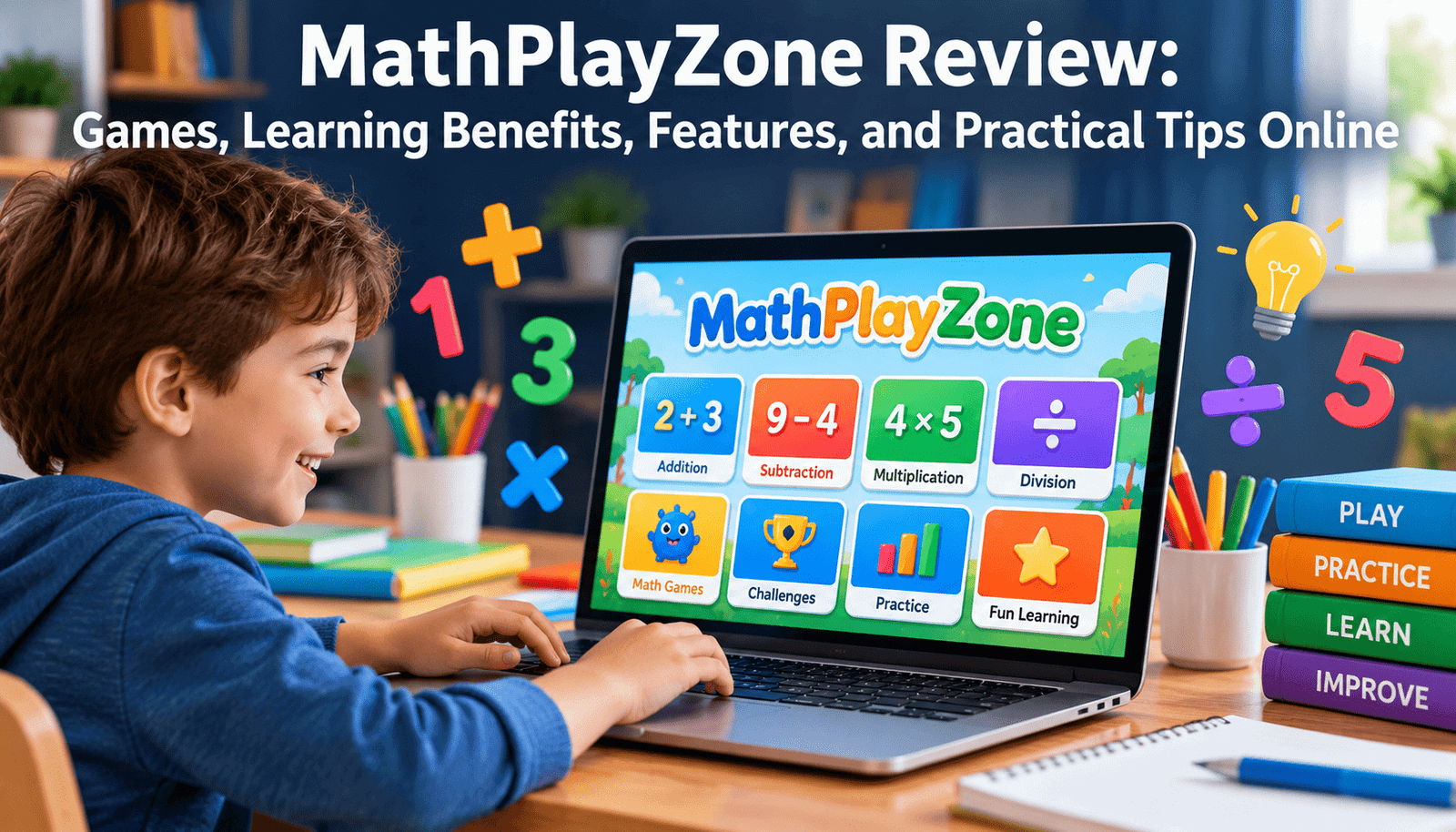
MathPlayZone is an online gaming website that combines arithmetic challenges, logic puzzles, science activities, history quizzes, and geography games. Visitors can explore browser-based activities such as Math Push, Math Boy, and Quiz Math without treating gaming as a replacement for formal education. The platform is best used for supplementary practice, helping learners revisit familiar concepts, test problem-solving strategies, and make educational screen time more purposeful.
What Is the Website and Who Can Benefit From It?
MathPlayZone is an online platform featuring games across several subject categories, including mathematics, science, history, geography, and arcade entertainment. Its mathematics section includes calculation-based challenges as well as puzzles that require players to plan their moves. This variety makes it relevant to students seeking extra practice, parents looking for educational activities, and casual players interested in combining entertainment with mental challenges.
The platform is not a complete school curriculum, and its games should not automatically be considered suitable for every age group. Their usefulness depends on the learner’s existing skills, reading ability, and familiarity with the instructions. Parents and teachers can preview activities before recommending them. Students should also remember that completing a game successfully is different from demonstrating a concept independently in homework, examinations, or everyday situations.
Which Mathematics Games Are Available?
The official website lists several mathematics activities with different objectives. Math Push combines number manipulation with strategic movement, while Math Boy presents arithmetic equations within a fantasy-themed game. Quiz Math challenges players to decide whether displayed addition or subtraction equations are correct. These formats offer different ways to practise calculations, allowing learners to select activities that match their preferences and current confidence.
Other listed games focus on reaching numerical targets. Let’s Reach 1000 asks players to build a running total through addition, while Let’s Reach Zero uses subtraction to reach zero within a time limit. Separate addition, subtraction, multiplication, and division games provide more direct calculation practice. Players who struggle with speed can begin by working out answers carefully before attempting timed rounds, reducing the temptation to guess.
How Math Push Works: Rules, Controls, and Strategy
Math Push is particularly interesting because it combines mathematics with spatial planning. According to the official game description, players push and arrange numbered blocks to form mathematical expressions that match values shown on barriers blocking the exit portal. The objective is therefore not simply to calculate an answer; players must also consider how moving a block affects the available space and their next possible moves.
The listed controls include the arrow keys or WASD for movement, Enter or Space to start, Z or U to undo, R to reset, and Esc or B to return to the menu. These controls can make the game more manageable when a move fails, although players should check the instructions displayed in the actual game in case controls change. A useful strategy is to inspect the target values first, plan a possible expression, and avoid moving blocks into positions that restrict later moves.
Science, History, and Geography Activities
The website extends beyond arithmetic through a selection of science games and quizzes. The Brain Lab uses an endless-runner format involving the three states of matter: solid, liquid, and gas. Smarty Pants: Science Quiz covers topics such as planets, the human body, and modern science, while The Magic of Science presents basic scientific concepts across interactive levels. These activities can introduce or reinforce ideas, but learners may still need explanations from textbooks or teachers.
History and geography games provide another option for educational exploration. Smarty Pants: History Quiz covers historical periods, including ancient civilizations, medieval times, and modern history. Smarty Pants: Geography Quiz focuses on countries, capitals, landmarks, and geographical facts, while Flags Maniac challenges players to identify national flags. These activities are useful for revision and general knowledge, but important facts should be checked against reliable learning resources when greater depth or accuracy is required.
Learning Benefits and Limitations
Educational games can make repeated practice more engaging by adding goals, feedback, and challenges. Arithmetic activities may help learners become more familiar with number facts, while logic puzzles encourage them to test possibilities and consider the consequences of individual moves. Subject quizzes can also prompt learners to retrieve information from memory. These are potential benefits rather than guaranteed outcomes, and progress depends on the quality of practice and the learner’s starting point.
There are limitations to consider. Timed games may reward quick answers without giving learners enough time to understand their mistakes. Repeatedly playing familiar levels can also create a sense of progress without demonstrating broader understanding. To address these issues, players should explain their reasoning, practise similar questions outside the game, and revisit concepts they find difficult. A balanced learning routine combines interactive activities with reading, written exercises, discussion, and real-world examples.
Game Comparison: Which Activity Should You Choose?
Choosing an activity according to a clear objective can make online practice more effective. Instead of opening games randomly, consider which skill needs attention and how success will be measured. The following comparison is based on the activities described on the official website.
| Game or category | Main focus | Practical learning objective |
| Math Push | Number expressions and strategy | Plan moves and solve mathematical targets |
| Math Boy | Arithmetic equations | Practise basic operations |
| Quiz Math | Addition and subtraction checks | Improve calculation accuracy |
| Let’s Reach 1000 | Running addition totals | Practise adding numbers toward a target |
| Let’s Reach Zero | Running subtraction totals | Understand subtraction and numerical changes |
| Science quizzes | Scientific knowledge | Review concepts and factual information |
| Geography games | Countries, capitals, and flags | Strengthen geographical recall |
For a learner who needs to improve multiplication recall, the multiplication activity is a more direct starting point than a general knowledge quiz. Someone who already understands arithmetic but enjoys strategic challenges may prefer Math Push. If the goal is science revision, a relevant quiz can provide a quick review before the learner reads a fuller explanation of the topic. Matching the activity to the objective helps keep practice focused.
How to Use the Platform Effectively
Start by opening the official website and selecting the relevant subject category. Read the game’s instructions before beginning, then complete a short session focused on one skill. If a game provides a score or timer, use it as feedback rather than as the only measure of success. After playing, identify one question or move that was difficult and work through the reasoning again without relying on the game.
A simple practice routine might involve five minutes of arithmetic, five minutes of a puzzle, and a short review of mistakes. Younger learners may benefit from adult guidance, especially when instructions are unfamiliar or questions involve concepts they have not studied. Teachers can also ask students to demonstrate a strategy on paper after completing a level. This connects interactive practice with independent problem-solving and makes it easier to see whether learning has actually taken place.
Safety, Privacy, and Parental Guidance
Before children use any online gaming website, parents should check its privacy information, advertising practices, external links, and suitability for the child’s age. Avoid entering unnecessary personal details, downloading unfamiliar files, or following unexpected prompts. An adult should supervise younger children and review the available content rather than assuming that every game on an educational website is automatically appropriate.
Screen time should remain balanced with sleep, physical activity, reading, and other offline interests. Families can agree on a reasonable session length and choose games that support a specific learning goal. If an activity causes frustration, encourages excessive play, or offers little educational value for the child, switching to a different resource is sensible. The aim is to make technology useful without allowing it to displace other important parts of learning.
Conclusion: Is This Platform Worth Trying?
MathPlayZone offers a varied collection of arithmetic games, number puzzles, science activities, history quizzes, and geography challenges. Its strongest appeal is the opportunity to practise different skills through interactive formats rather than relying exclusively on conventional exercises. Math Push stands out for combining calculation with planning, while the separate arithmetic games provide more direct opportunities to review basic operations.
The platform is most useful when learners choose activities with a clear purpose and follow up their game sessions with independent practice. Parents and teachers should review suitability, encourage explanations of incorrect answers, and keep screen time balanced. It can be a helpful supplementary resource, but its educational value depends on how learners use it and whether the activities support their broader learning goals.
Frequently Asked Questions
1. Is MathPlayZone free to use?
The website presents browser-based games, but pricing, advertisements, and access conditions can change. Check the current official website for the latest details before using it.
2. Which game is best for practising arithmetic?
Math Boy, Quiz Math, and the separate addition, subtraction, multiplication, and division games are direct options. The best choice depends on the operation the learner wants to practise.
3. Can teachers use these games in the classroom?
Teachers may use suitable activities for supplementary practice, warm-ups, or revision. They should preview each game and connect it to the lesson objective.
4. Do educational games guarantee better mathematics results?
No. Games can provide additional practice, but better results depend on understanding, regular review, feedback, and the ability to solve problems independently.