

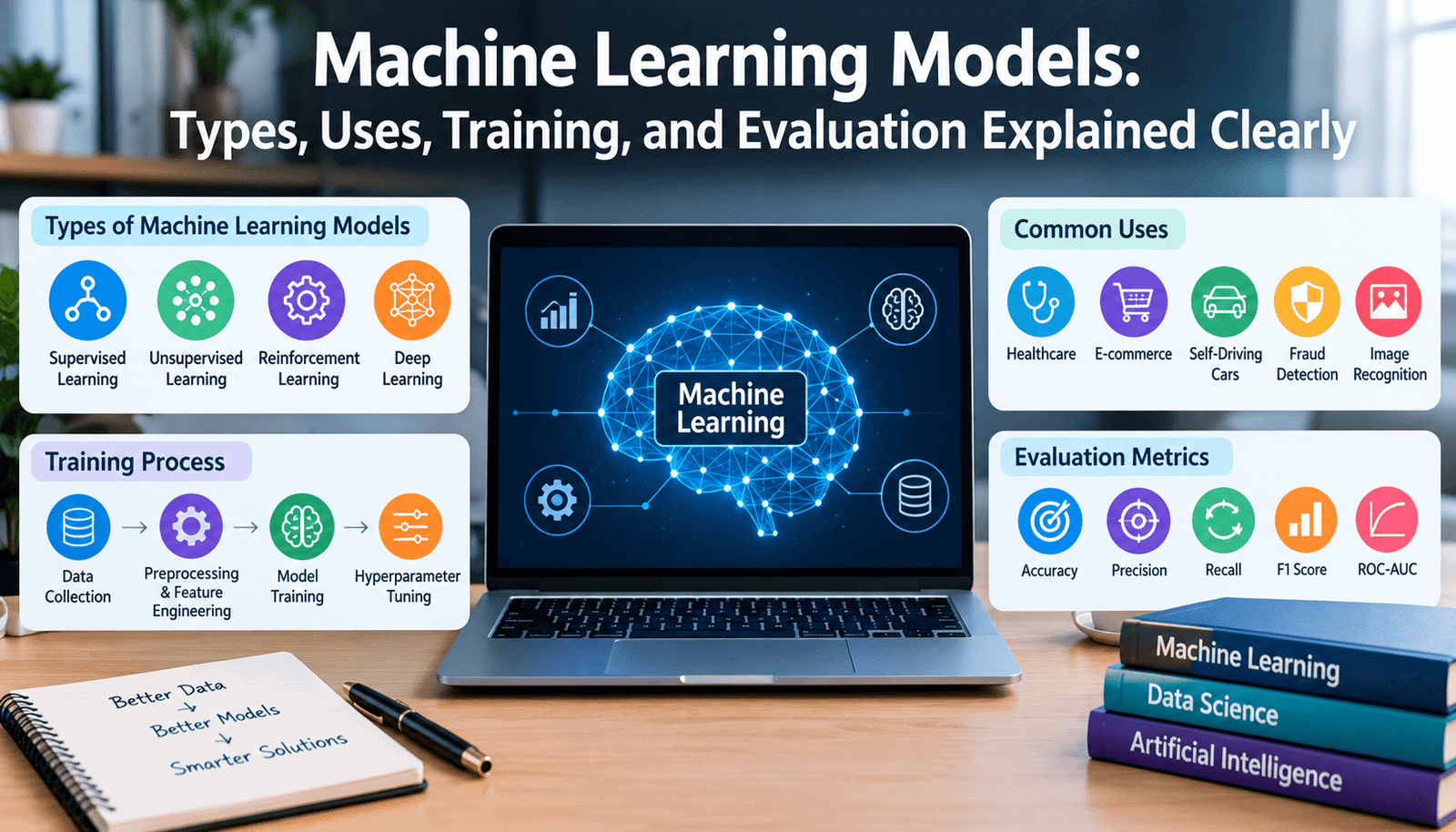
Machine learning models are computational systems that learn patterns from data to make predictions, identify relationships, classify information, or generate useful outputs. They are trained using algorithms and examples, then evaluated on data they have not seen before. Common approaches include regression, decision trees, clustering, support vector machines, neural networks, and ensemble learning, each suited to different problems.
What Are Machine Learning Models?
A machine learning model is the result of a training process in which an algorithm learns relationships from data. Instead of relying entirely on manually written rules, the system adjusts its internal parameters to produce useful predictions or decisions. For example, a retailer can analyze historical purchases to estimate future demand, while a bank can assess transaction patterns to identify potentially fraudulent activity.
The model itself is different from the algorithm used to train it. An algorithm defines the learning procedure, while the trained model contains the learned parameters or structure used to make predictions. Understanding this distinction helps businesses and beginners evaluate machine learning projects more accurately. A successful model is not simply one that performs well during training; it should also work reliably on relevant, previously unseen data.
Main Types of Learning Approaches
Supervised learning uses labeled examples, meaning the training data includes the correct output for each example. It is commonly used for classification and regression. Classification predicts categories, such as whether an email is spam, while regression estimates numerical values, such as a property’s likely selling price. Decision trees, linear regression, logistic regression, and support vector machines are widely used techniques in this category.
Unsupervised learning works with data that does not have predefined target labels. Its purpose is to discover patterns, groups, or underlying structures. For example, a marketing team might use clustering to identify customer segments based on purchasing behavior. Reinforcement learning takes a different approach: an agent learns through actions, feedback, and rewards. The right approach depends on the available data, the desired outcome, and the environment in which the system will operate.
Popular Model Types and Their Uses
Different techniques solve different problems, so there is no single approach that performs best in every situation. Linear regression is useful for estimating continuous values, whereas logistic regression predicts class probabilities. Decision trees offer relatively interpretable rules, and random forests combine multiple trees to improve predictive performance. Support vector machines can work well on suitable classification tasks, while k-nearest neighbors makes predictions based on similar examples in the training data.
Neural networks are particularly useful for complex patterns in images, speech, text, and other high-dimensional information. Deep learning uses neural networks with multiple layers to learn increasingly complex representations. Gradient boosting methods, including implementations such as XGBoost and LightGBM, are popular for structured business data. The best choice depends on dataset size, feature quality, computing resources, interpretability requirements, and the cost of incorrect predictions.
| Technique | Common purpose | Important consideration |
| Linear regression | Predicting numerical values | Assumes a specified relationship between features and output |
| Logistic regression | Classification | Often provides useful class probabilities |
| Decision tree | Classification or regression | Can overfit without suitable controls |
| Random forest | Classification or regression | Combines predictions from multiple trees |
| K-means clustering | Grouping similar records | Requires choosing the number of clusters |
| Neural network | Complex patterns in images, text, and speech | May require substantial data and computing power |
| Gradient boosting | Structured-data prediction | Requires careful tuning and validation |
How Training and Testing Work
Training begins with collecting relevant data and defining the problem the system must solve. Data is cleaned, inconsistent records are reviewed, and useful features are prepared. The algorithm then learns from the training dataset by adjusting its parameters to reduce a chosen loss function. The loss function measures the difference between predictions and target values, giving the training procedure a measurable objective to improve.
After training, the model must be tested using data that was not used to fit it. A common workflow separates information into training, validation, and test sets. Training data supports learning, validation data helps select settings, and test data provides a final performance estimate. For time-dependent problems, splitting data chronologically may be more appropriate than random splitting. Data leakage must also be prevented because information from the future or target can create misleadingly strong results.
Evaluation Metrics That Matter
Accuracy measures the proportion of predictions that are correct, but it can be misleading when classes are imbalanced. For instance, a system that labels almost every transaction as legitimate could achieve high accuracy if fraudulent transactions are rare. Precision measures how many predicted positive cases are actually positive, while recall measures how many actual positive cases the system identifies. The F1 score combines precision and recall into one measure.
For regression tasks, mean absolute error measures average absolute prediction errors, while root mean squared error gives greater weight to large errors. The coefficient of determination, or R-squared, can help describe how well predictions explain variation in the target under a particular evaluation setup. Select metrics based on the real-world consequences of mistakes. A medical screening system, a sales forecasting tool, and a spam filter can require very different definitions of success.
Overfitting, Underfitting, and Model Reliability
Overfitting occurs when a model learns the training data too closely, including random noise or accidental patterns. It may perform exceptionally well on training examples but poorly on new information. Underfitting occurs when a model is too simple, or insufficiently trained, to capture meaningful relationships. Comparing training and validation performance can help reveal both problems. Learning curves and validation curves are useful diagnostic tools for understanding whether more data or different settings may help. Scikit-learn’s model evaluation guidance explains these patterns in detail.
Several practical measures can improve reliability. Regularization discourages unnecessarily complex solutions, cross-validation helps estimate performance across different data splits, and feature selection can reduce irrelevant information. More training data may help when the existing sample is too limited, although quality matters as much as quantity. Teams should also examine performance across meaningful groups, monitor changing data patterns, and investigate unusual errors. A reliable system is one that performs consistently under the conditions where people actually intend to use it.
Real-World Applications Across Industries
Businesses use machine learning models to forecast demand, recommend products, predict equipment failures, and organize customer information. In finance, predictive systems can help flag suspicious transactions and estimate credit risk, subject to appropriate controls and regulatory requirements. Healthcare researchers use machine learning to analyze medical images, support research, and identify patterns in clinical data. These applications require careful validation, privacy protections, and human oversight where errors could have serious consequences.
In transportation, prediction systems can estimate arrival times and help optimize routes. Manufacturers can analyze sensor readings to detect early signs of equipment problems. Online platforms use recommendation methods to rank content or products based on relevance signals. Language technologies can classify documents, summarize text, and support conversational tools. The benefits depend on the quality of the underlying data, the suitability of the approach, and whether the system is evaluated against the needs of its intended users.
How to Choose the Right Approach
Start by defining the decision the system must support. Determine whether the desired output is a number, a category, a group, a ranking, or a sequence of actions. Next, review the amount and quality of available data, the consequences of errors, and any requirements for explainability. A simple baseline often provides a valuable point of comparison before more sophisticated methods are introduced.
A practical selection process includes these steps:
- Establish a measurable business or research objective.
- Inspect the data for missing values, imbalance, bias, and leakage.
- Build a simple baseline before testing complex alternatives.
- Compare candidates using suitable validation methods and metrics.
- Consider inference speed, maintenance cost, interpretability, and privacy.
- Test the selected solution under realistic operating conditions.
Avoid choosing a technique solely because it is popular or technically advanced. A simpler model can be easier to explain, cheaper to operate, and sufficiently accurate for the task. More complex approaches are justified when their measurable benefits outweigh their additional costs and operational risks.
Deployment, Monitoring, and Continuous Improvement
A trained system does not automatically remain effective after deployment. Real-world data can change as customer behavior, market conditions, equipment, or business processes evolve. This is commonly described as data drift or concept drift, depending on what changes. Teams should monitor prediction quality when reliable outcome labels become available, track operational indicators such as latency and failure rates, and establish clear criteria for investigating declining performance.
Maintenance also includes version control, reproducible training procedures, access restrictions, documentation, and rollback plans. Sensitive information should be handled according to applicable privacy and security requirements. When a model influences important decisions, organizations should define who is accountable for reviewing its outputs and correcting errors. Retraining should follow evidence and established evaluation criteria rather than an arbitrary schedule alone. Good monitoring turns deployment into a managed lifecycle instead of a one-time technical task.
Conclusion: Building Better Predictive Systems
Machine learning offers practical ways to find patterns, automate predictions, and support decisions across many industries. The strongest results come from matching the learning approach to a clearly defined problem, preparing trustworthy data, choosing appropriate evaluation metrics, and testing performance on unseen examples. Model complexity should be justified by measurable improvements rather than novelty.
For anyone starting a project, the most useful first step is to establish a baseline and measure its performance honestly. Then compare alternatives, investigate errors, and assess how the system behaves in realistic conditions. Continued monitoring, transparent documentation, and responsible human oversight help maintain usefulness after deployment. Ultimately, good machine learning is not just about making accurate predictions; it is about producing dependable results that solve a real problem.
Frequently Asked Questions
1. What are machine learning models used for?
They are used for prediction, classification, clustering, recommendation, anomaly detection, forecasting, and tasks involving images, audio, or text.
2. Which type is best for beginners?
Linear regression and decision trees are useful starting points because their basic concepts are relatively easy to understand. Beginners can then explore classification, clustering, and neural networks.
3. What is the difference between an algorithm and a trained model?
An algorithm is the procedure used to learn from data. A trained model is the learned result that applies those patterns to new inputs.
4. How can model accuracy be improved?
Improve data quality, prevent data leakage, select appropriate features, compare suitable algorithms, tune parameters using validation data, and evaluate performance with metrics that match the task.